THE NIGHT EVERYTHING CHANGED…
![]()
It was May of last year, in a nephrologist's office in Naperville.
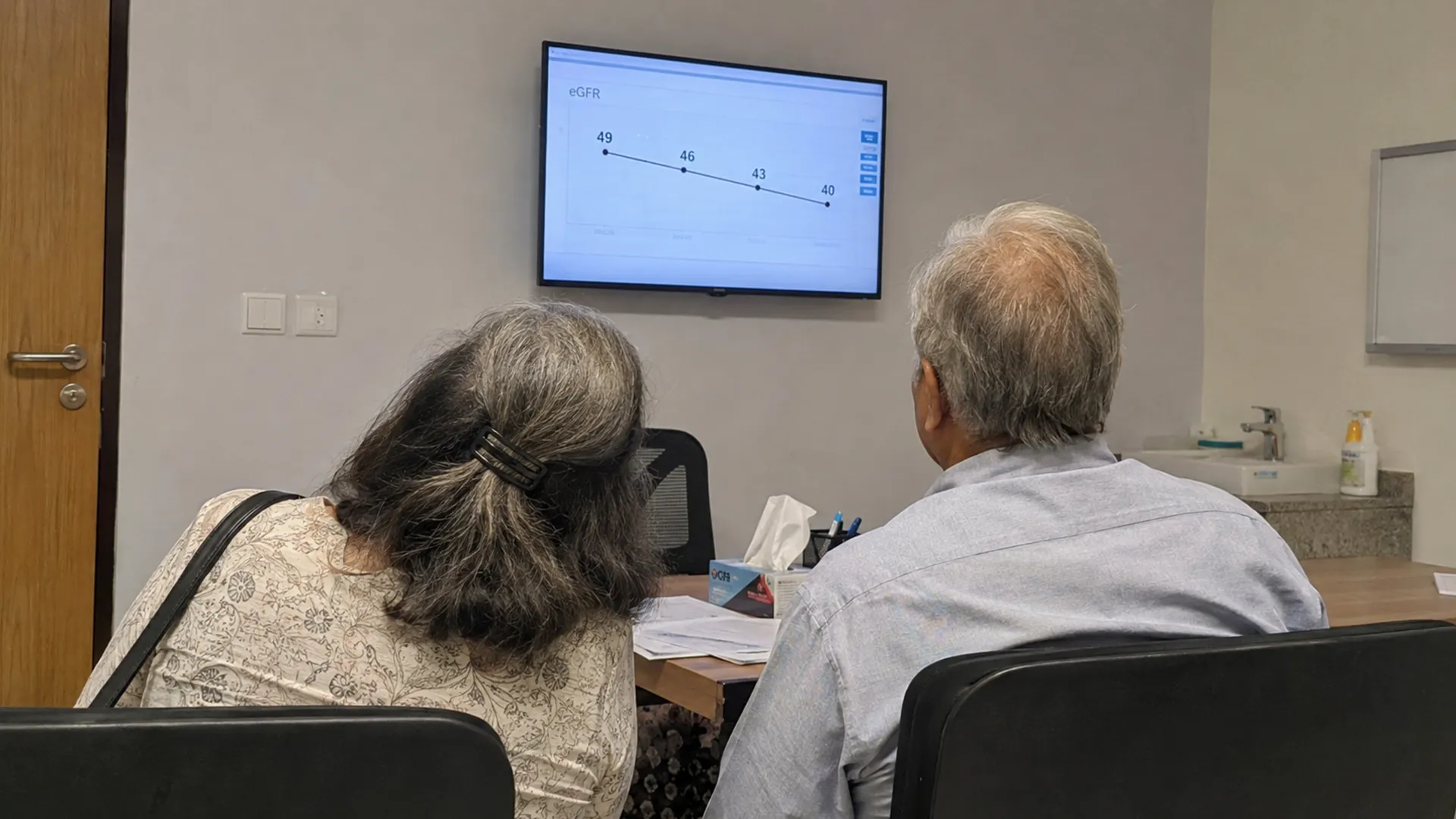
He pulled Linda's labs up on the wall screen and turned it so we could both see. Then he said:
"Linda, I think we should talk about access placement."
I didn't know what those words meant. Linda did. She'd been reading on her phone for three months.
I watched her face go still.
A fistula. They wanted to start preparing her body for dialysis.
She nodded the way you nod when somebody tells you the date of your own funeral.
He was kind about it, and completely honest, and I've thought about what he said every day since:
"We can slow this. We can manage it. We can put you on the transplant list if it comes to that. But we don't reverse this. The nephrons that are gone are gone. We protect what's left."
The surgical consult went on the calendar for October 11th.
Here is what the two years before that appointment looked like.
March, two years ago. Her annual physical. She was 62 and she felt fine.
eGFR 49.
Three months later:
46.
Three months after that:
43.
And again:
40.
Four quarters of monitor and watch. Four quarters of Linda reading a new printout from the patient portal at our kitchen table and not saying anything. Four quarters of me asking what the
do
ctor wanted us to do, and Linda saying he wanted us to keep doing what we were doing.
And we were doing plenty.
![]()
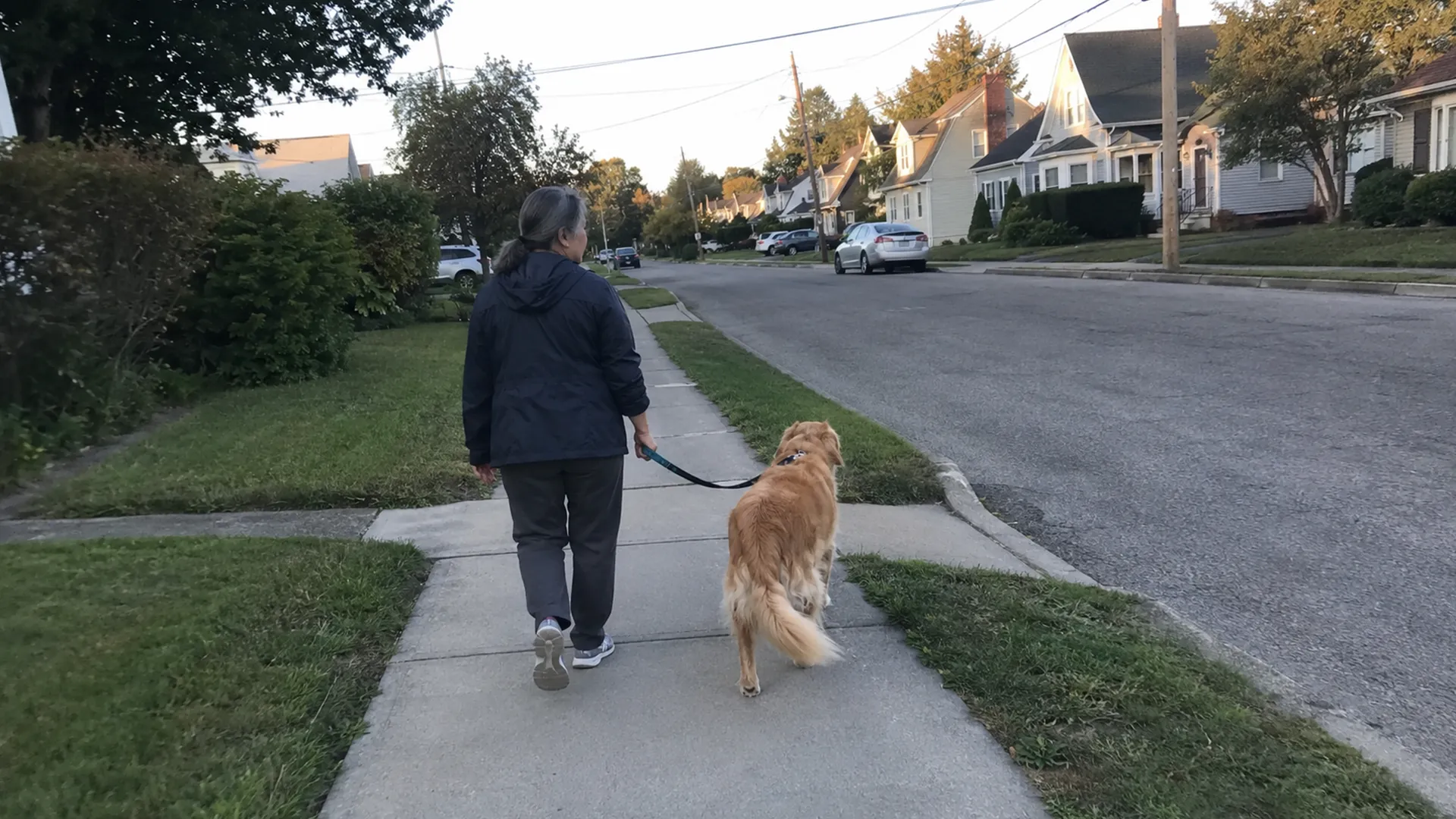
She'd been on lisinopril since she was 54. Sodium under 1,800. Walked the dog every morning before coffee. Weighed herself every Sunday and wrote it on the fridge calendar. In 41 years of marriage Linda has been the one booking
my
physicals. She is the careful one. That has always been the arrangement.
The morning after that appointment I opened the cabinet above the coffee maker and lined up everything she'd been taking.
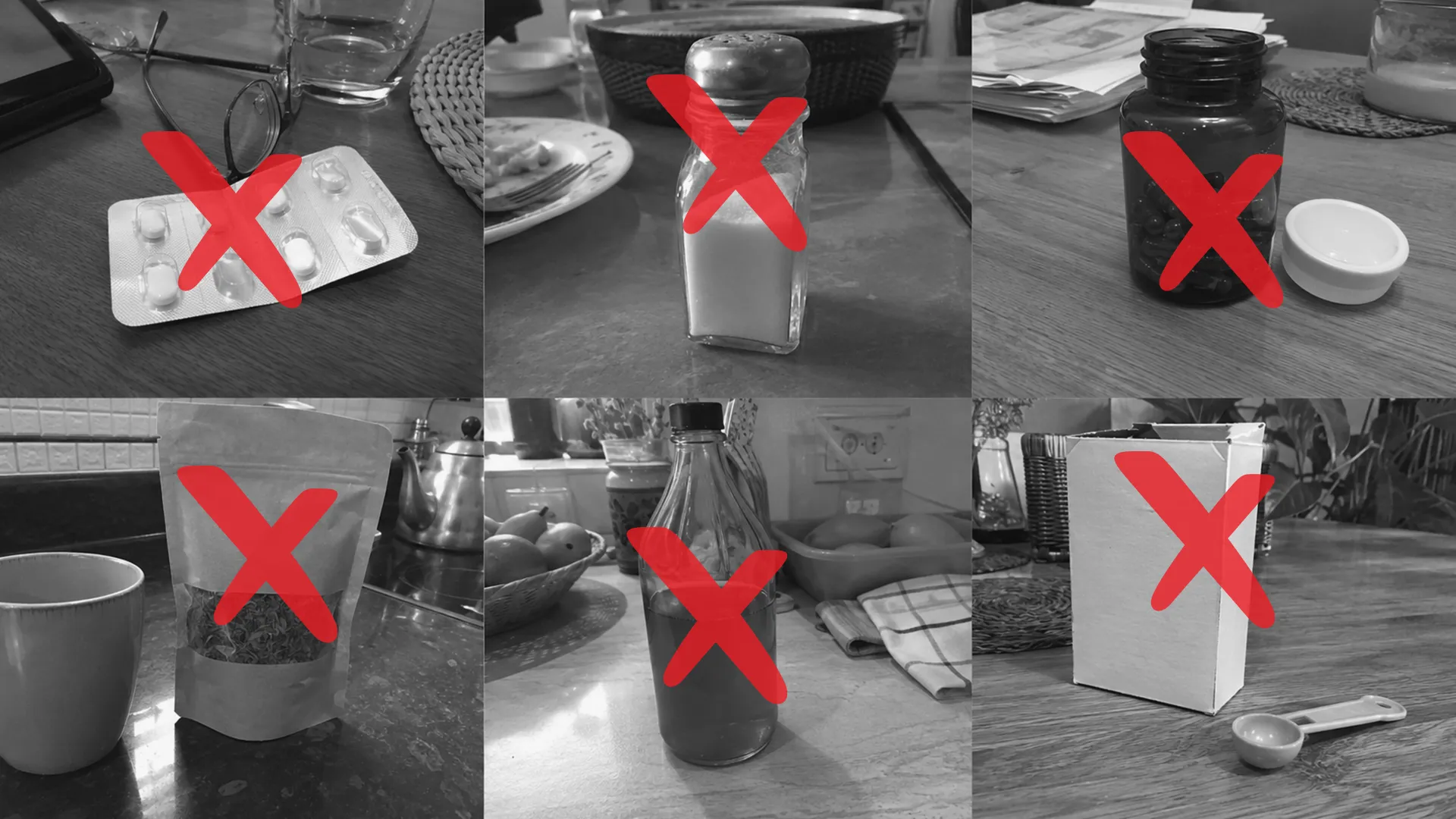
Cranberry capsules, because her mother took them. A "kidney support tea" from the health food store that smelled like cut grass. Apple cider vinegar from a forum. A box of baking soda with masking tape on it reading "1/2 tsp AM." CoQ10. Magnesium citrate. A $42 kidney capsule off Amazon with sixteen ingredients and a "proprietary blend" disclosure, which is the phrase that means nobody has to tell you how much of anything is actually in there.
Eleven bottles. Some of them for years.
The cranberry is for urinary tract infections and has nothing to do with chronic kidney disease. The health food store tea was the same two herbs already inside the Amazon capsule, so she'd been double-dosing the same thing out of two different containers. The vinegar was vinegar.
She had taken all of it, exactly as directed, and her eGFR had gone from 49 to a surgical consult.
Then came a Wednesday in June.
She came in from the dog walk, sat down at the kitchen table without taking her windbreaker off, and said:
"Lou. I don't think I can do this."
I held her hand and said we'd figure something else out.
She said,
"There isn't something else. He told us."
She went to bed at 7:30. I sat at that table until midnight.
That's the night I started doing something different. Because I couldn't sit and watch my wife of 41 years prepare her arm for a machine while everybody in the chain told us to keep doing what we were doing.
THE DISCOVERY THAT CHANGED HOW I SAW ALL OF IT
Two weeks later my own physical came back.
eGFR 61.
I sat at that same table and understood, properly, that I was standing exactly where Linda had been standing eighteen months earlier. And I knew exactly what was coming next.
Come back in three months.
I couldn't sit and watch it happen to both of us.
So I started reading. Badly, the way an engineer reads a discipline that isn't his. Medical journals I had no business opening. National registry reports. Most nights, for weeks, after Linda went up.
Four things came up over and over. Not one of them had been said out loud to us in two years of appointments.
Around nine in ten people with chronic kidney disease don't know they have it.
They feel fine. They find out on a printout, years in.
About four in ten people are still alive five years after starting dialysis.
Not nine in ten. Four.
Cardiovascular disease kills roughly half of long-term dialysis patients before their kidneys do.
The strain on the heart is enormous.
By 60, you have already lost around 40% of the filtering units you were born with.
That last one is the one that made me put the laptop down and walk outside.
Nobody is hiding any of this. It's published, it's findable, and none of it is controversial. It just isn't the kind of thing that fits in a fifteen-minute appointment, and there is nobody in the chain whose job it is to say it out loud.
Which left me with the question nobody had answered in two years: If her numbers were falling every quarter, what exactly was doing the falling? And was one single thing we were doing actually stopping it?
THE REAL REASON KIDNEYS KEEP DECLINING (THAT NOBODY EXPLAINS)
Here's what I worked out, explained the way I had to explain it to myself.
Your kidneys aren't one filter. They're around a million tiny ones each, called nephrons, working in parallel.
You are born with every one you will ever have. They do not regenerate. Ever.
Think of a kitchen strainer that's been catching debris for sixty years. Some of the holes are sealed over now and you cannot open them back up. Whatever is still clear is all you have left to work with.
Now here's the part that changed everything for me.
What seals those holes is not the number on the printout. The number is only the reading.
What seals them is the daily load. Oxidative stress, inflammation, and pressure, grinding away at the vessel walls and at the filters themselves. Every hour. Whether or not anybody is measuring.
And that load does not pause between blood draws.
Linda wasn't being damaged because her eGFR was 49. She was being scarred quietly, quarter after quarter, while we sat in our kitchen waiting for the next appointment and called it a plan.
In my old line of work, if you tell a client you're going to monitor a crack and come back in three months, you had better also be telling them what will stop the crack getting worse in the meantime. The measurement is never the intervention. It's the first thing you learn.
We had a measurement schedule. We thought we had a treatment plan.
And nothing on that shelf above the coffee maker was carrying any load at all. Nothing was reducing oxidative burden. Nothing was supporting her vessel walls. Nothing was taking pressure off the filters she still had.
So I stopped asking how to manage this, and started asking a completely different question:
How do we take some of the daily load off the filters she has left?
THE 8-MINUTE ANSWER THAT WAS HIDING IN PLAIN SIGHT
![]()
I found the answer in a place I was not expecting, from somebody with no reason on earth to lie to me.
After Linda's diagnosis I'd joined three Stage 3 CKD support groups on Facebook. Mostly I read and didn't post.
A woman put something up that stopped me.
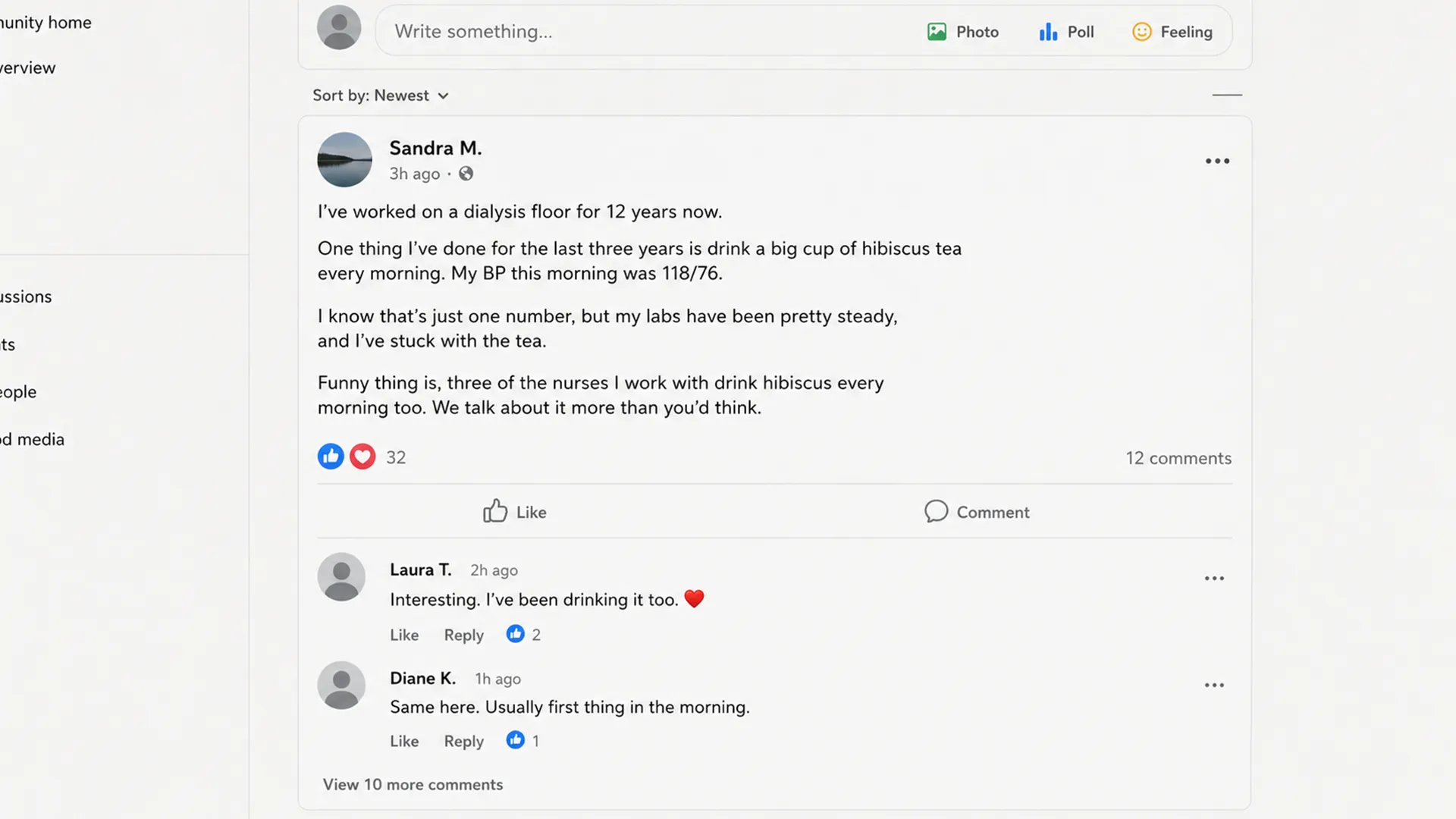
She was an RN. Twelve years working the dialysis floor of a hospital in the upper Midwest. Over a decade watching kidney decline up close, every day, every patient, every conversation about access placement and transplant lists.
She wrote that she drinks
hibiscus
every morning, and has done for three years. That her blood pressure sits at 118/76. That her labs hold steady. And that three of the nurses on her floor do exactly the same thing, and they talk about it a lot.
I almost scrolled past it.
Hibiscus?
Tea?
Linda and I have had hibiscus tea. The boxes at the grocery store with the flower on the front. It tastes fine. It's tea. It isn't medicine.
But I could not stop thinking about it.
Because that woman works on a dialysis floor. Every single day. She is surrounded by exactly the thing my wife was scheduled to start preparing for in eight weeks.
And she isn't in a chair. Neither are three of her colleagues.
They are watching what happens to everybody else, and they are quietly doing something different about it.
So I went and read the research, and the mechanism turned out not to be mysterious at all.
The antioxidants in hibiscus, the anthocyanins and polyphenols and flavonoids and organic acids, do the exact thing I'd spent four months trying to find something to do. They help bring the oxidative and inflammatory burden down. They support the vessel walls and healthy blood pressure. Which takes daily load off the filters that are still working, without forcing the kidneys to work any harder.
Load off. Not more work.
For the first time in two years, something I was reading made engineering sense.
PEOPLE HAVE BEEN DRINKING THIS FOR THOUSANDS OF YEARS. SO I WENT AND BOUGHT SOME.
![]()
And it turns out that nurse and her three colleagues are a rounding error.
Egypt has been drinking whole-flower hibiscus for thousands of years. They call it karkadeh, served hot in winter and iced in summer, and it has been part of daily life there since before most of modern medicine existed. Sudan drinks it. Mexico has agua de jamaica, in every home and on half the street corners.
Those are not populations that show the hypertension and kidney-decline curves we do.
So this isn't a new compound out of a laboratory somewhere. It is one of the oldest daily drinks on earth. And a nurse who watches kidney failure for a living is taking it every morning before her shift, along with three of the people she works beside.
That was enough for me to try it.
So I drove to the grocery store, because my instinct is always to test small before committing to anything.
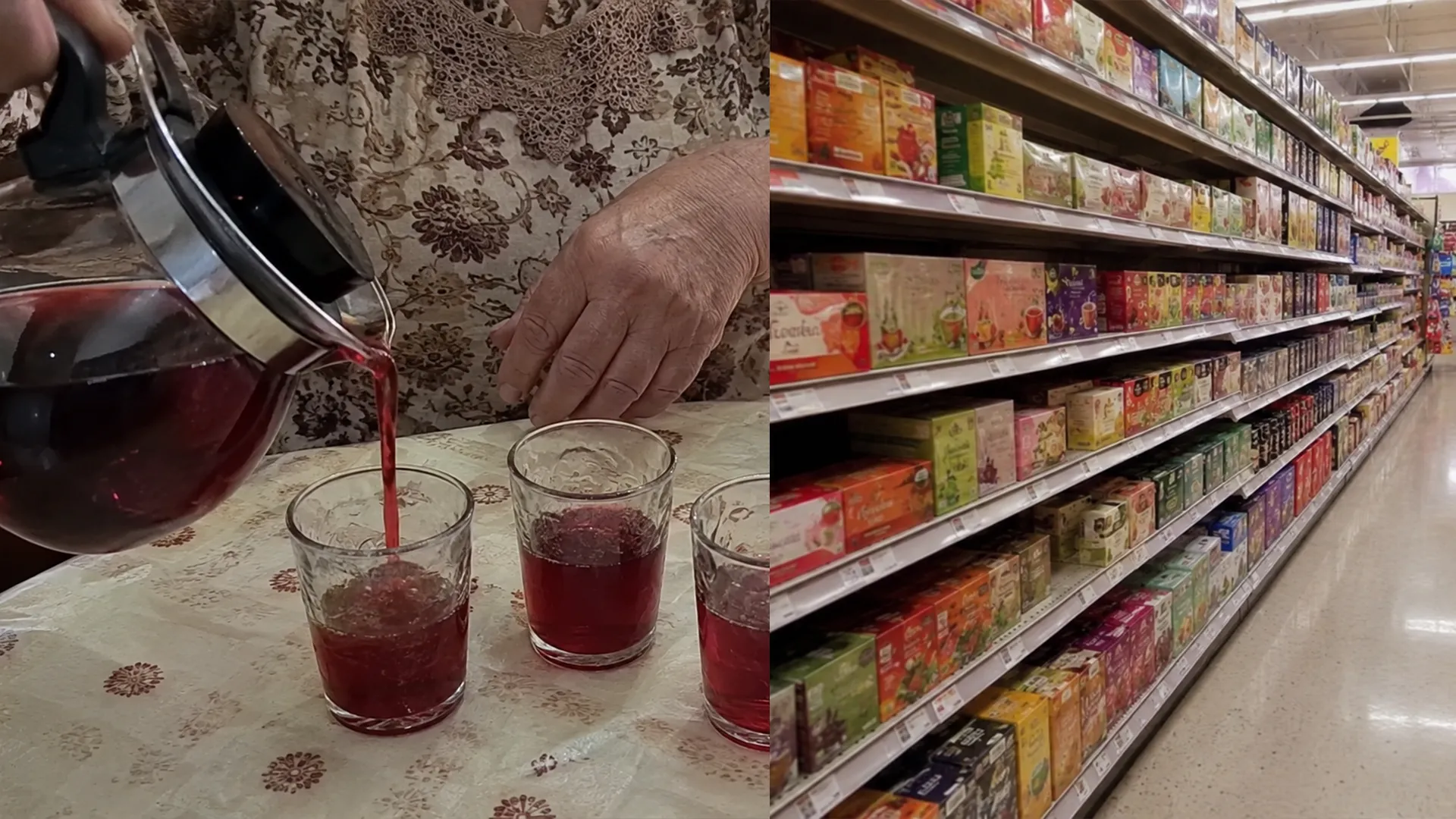
The tea aisle had four kinds of hibiscus. A well-known brand with a cartoon flower on the box, $3.99 for twenty bags. I bought that one. Linda and I had drunk it on and off for thirty years. The nurse said hibiscus. This was hibiscus.
Linda started drinking it, one cup in the morning and one after dinner. I checked her home blood pressure cuff every morning, the way she used to write her weight on the fridge.
Week one:
138/85. 137/86. 138/85.
Week two:
136/85. 136/84. 135/85.
Week three:
134/85. 134/84. 133/85.
Something was happening. Not much. And her energy hadn't shifted at all. She was still going to bed at eight.
I wanted it to be enough.
She'd been on it six weeks when she went in for her quarterly panel.
The nephrologist rang on a Thursday. Her eGFR had come in at
39
.
Down another point. The consult was still on for October 11th.
She sat at the kitchen table for an hour with the printout in one hand and an empty mug in the other.
One more point.
We'd been doing something. Just not enough of the something to matter.
That should have been the end of it. I'd tried the thing, the thing had failed, and there was a surgical date on the calendar five weeks out.
Except it wouldn't sit right with me.
Because a woman who works a dialysis floor was drinking the same thing I had just bought at the grocery store, and her numbers were holding, and my wife's weren't.
Same flower. Opposite results.
So I went back to the laptop one more time.
WHY ALMOST EVERY HIBISCUS ON THE SHELF IS USELESS
This time I skipped the wellness articles and went straight to the studies underneath them. Methods sections. Preparation protocols. Dosing.
It took about an hour to find the answer, and when I found it I had to go and stand in the garden.
The hibiscus in the research was nothing like the hibiscus in my kitchen.
The clinical work used standardised whole-flower preparations, with anthocyanin content measured in the
hundreds of milligrams per cup
.
Ordinary blended tea-bag hibiscus delivers something like
a tenth
of that.
I had been giving my wife a teaspoon of what the research was using a cup of.
I read the box again. Hibiscus was the third or fourth ingredient by weight, behind rosehips and lemongrass. I'd been brewing her peppermint tea with a bit of hibiscus in it and wondering why her numbers weren't holding.
Then I went back to that nurse's post and found the word I had skipped straight over.
She hadn't written "hibiscus." She had written
high-anthocyanin hibiscus
.
I'd ignored the qualifier because I didn't know what it meant. Here is what it means.
Most hibiscus sold in this country is broken petals and dust. It is the leftovers, after the whole flowers have gone to specialty buyers. Grown on low-altitude flatland farms because that is where the volume is. Machine-stripped before peak harvest because that fits the buyers' schedules. Processed industrially in large batches. And commonly sprayed with the same pesticides that are themselves a load on the kidneys.
The compounds that do the work are concentrated in the whole flower at peak harvest, and they degrade fast once the flower is broken up and exposed to air. By the time petal fragments sit in a tea bag on a shelf for nine months, most of what you were trying to buy is already gone.
The hibiscus that actually holds its anthocyanins meets five conditions:
1.
Whole flower
, not broken petals
2.
Hand-picked at peak harvest
, not machine-stripped
3.
Grown at 4,500 feet or higher
, where the plant produces more anthocyanins under UV stress
4.
Traditionally processed
, not industrially
5.
Organic
, because pesticide residue is one more load on the organ you are trying to protect
Five things. Miss one and you are holding coloured water.
I rang the company that made the $15.99 wellness tin I'd seen in the same aisle, because by then I had stopped trusting packaging entirely. The woman who answered could not have been more helpful. Theirs was machine-stripped, from a farm in Yemen, at sea level.
It failed two of the five.
So I started ringing others.
Almost every hibiscus product sold in America fails at least one of those five conditions. Most fail two or three.
Not because anybody is cheating. Because meeting all five costs more, yields less, and is completely invisible on a shelf. There is no commercial reason for a company to do it, and no way at all for a customer to tell the difference.
Which is how a country ends up with an entire tea aisle of a plant people have used for thousands of years, and almost none of it doing what the plant is supposed to do.
Egypt drinks the flower.
We've been drinking the dust.
INTRODUCING THE ONLY HIBISCUS THAT MEETS ALL FIVE CONDITIONS
It took me another three weeks of phone calls to find one that satisfies all five.
It's called
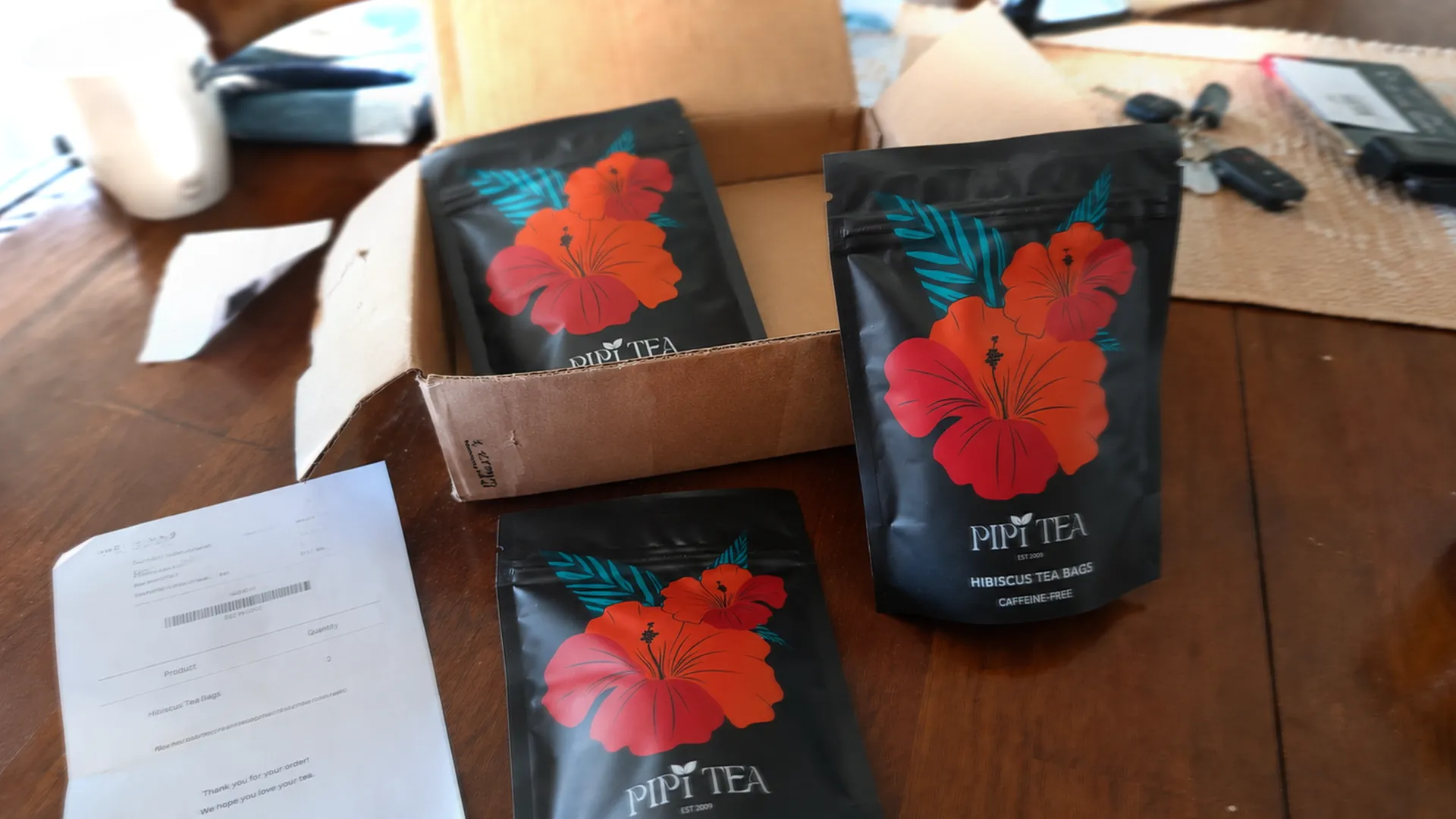
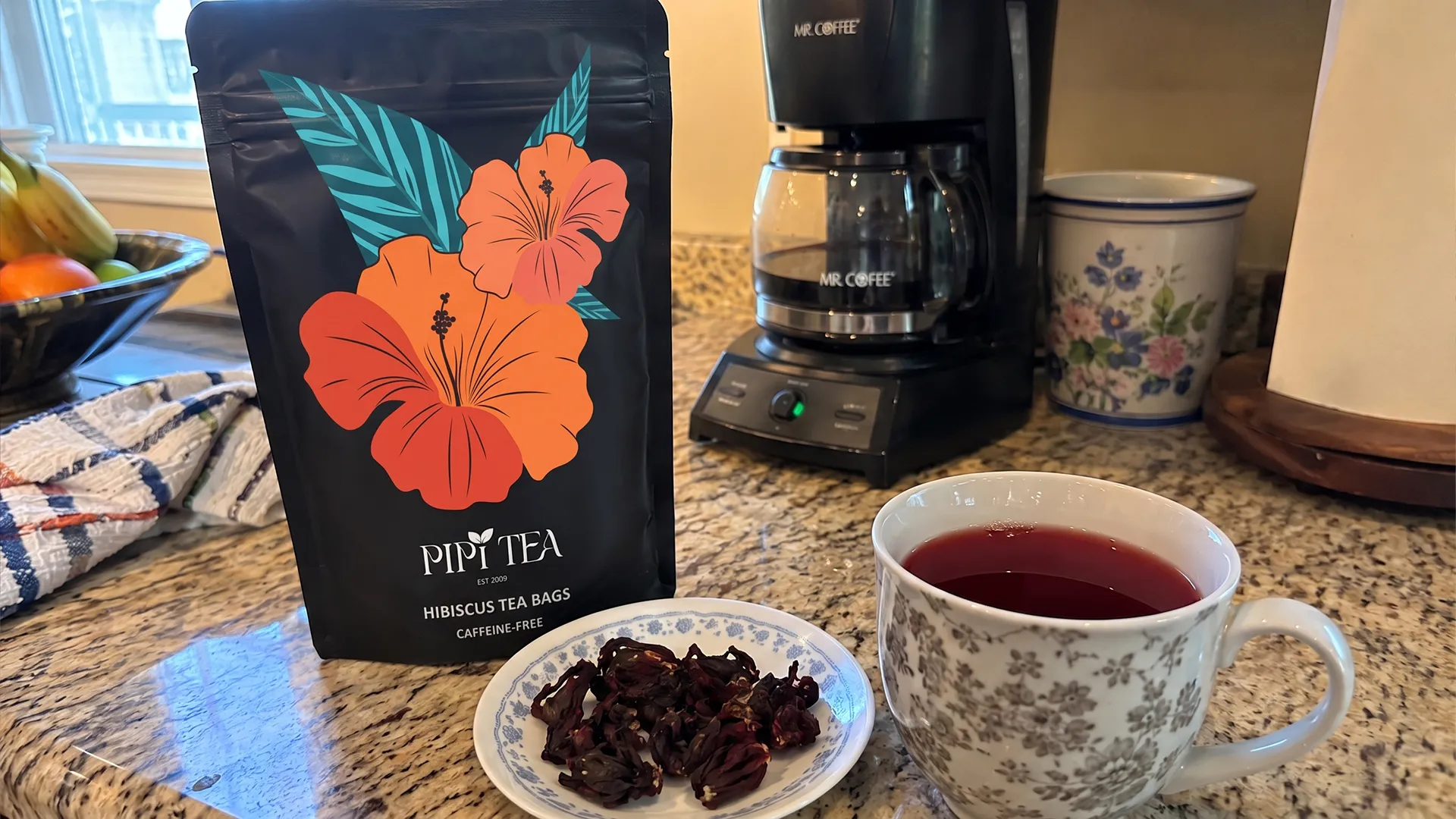
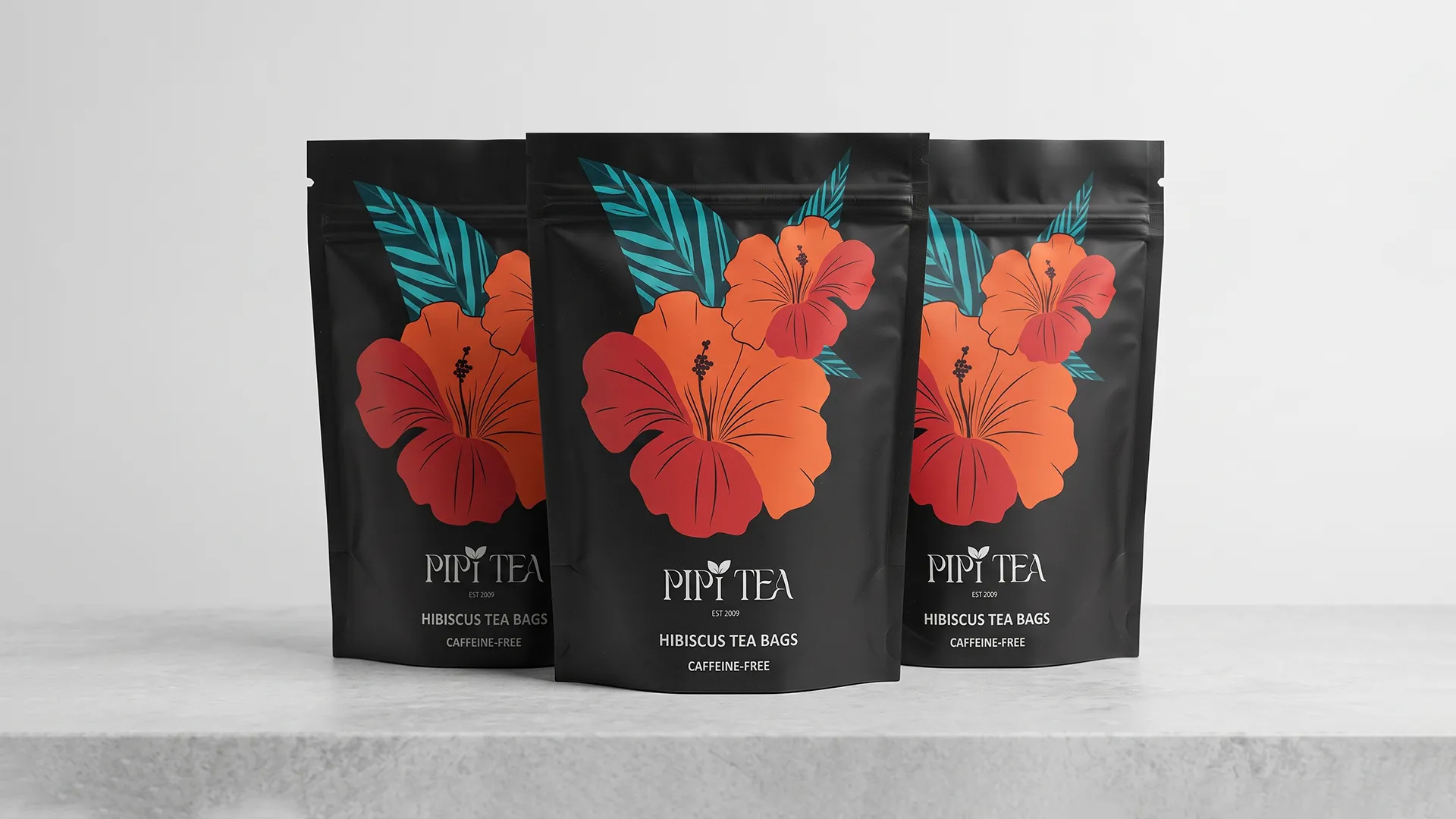
PiPi Tea
.
It's hibiscus. That is genuinely all it is. What makes it different is the specification:
●
Whole flower
, not broken petals or dust
●
Hand-picked at peak harvest
, not machine-stripped
●
Grown at 4,500 feet and above
●
Traditionally processed
, not industrially
●
Certified organic
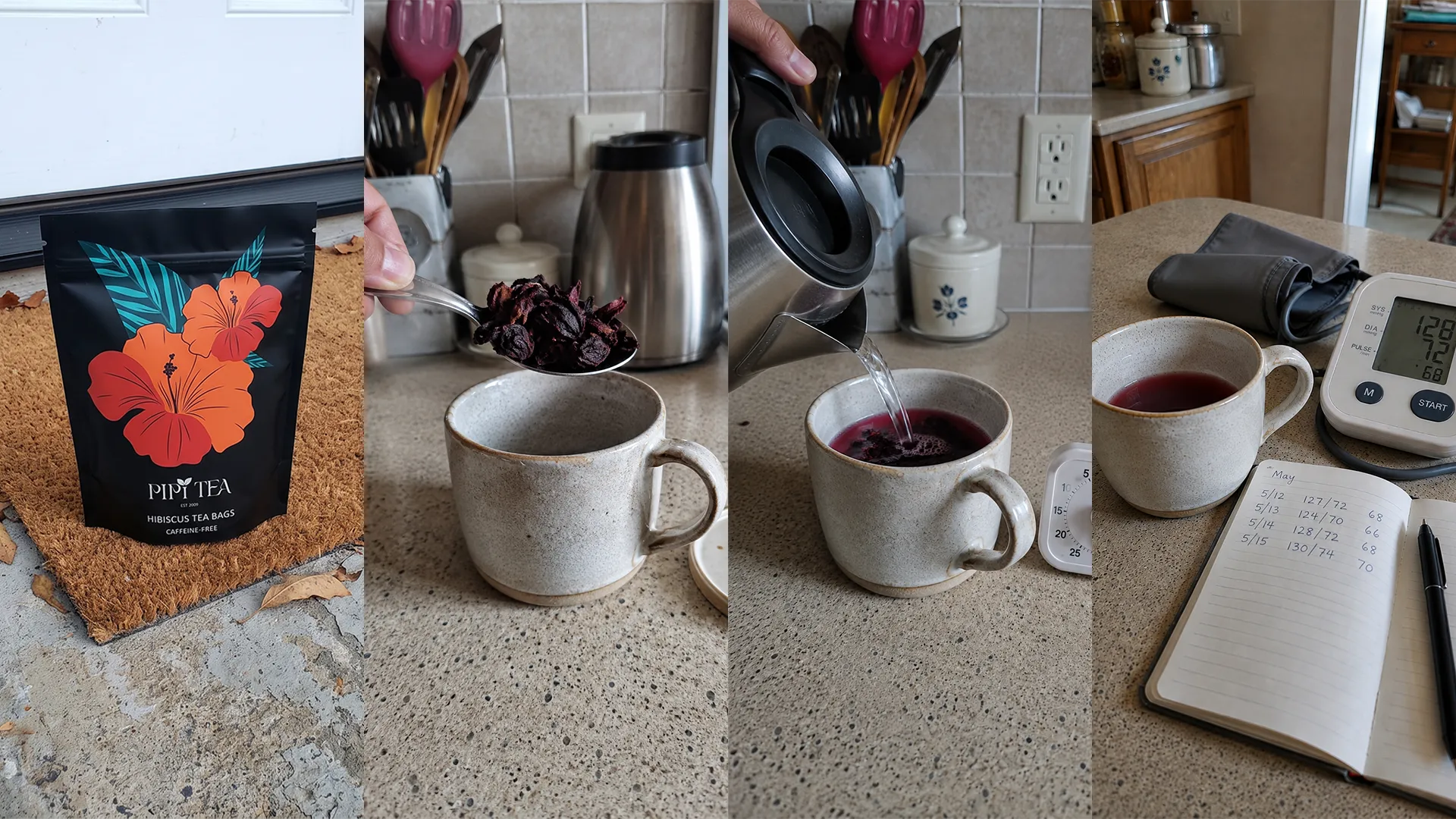
One tablespoon. Hot water. Steep eight minutes. One cup a day.
That is the entire protocol. It takes less time than filling a weekly pill organiser and it doesn't take a single thing off your plate.
And I still didn't order it.
Not after that cabinet. Not after six weeks of grocery tea and another point off her eGFR. I wasn't going to trust something new because the internet said so.
So I rang Linda's nephrologist. The man who'd put the surgical consult on the calendar. I asked his front desk for fifteen minutes, and he called me back on a Friday evening from his car.
I told him what I'd found, and about the six weeks of grocery tea, and I asked him straight out whether the form really made that much difference, or whether I was grasping at straws because my wife had a surgical date I couldn't accept.
He was quiet for a long time. Then he said:
"Lou, the research on hibiscus anthocyanins and kidney function is some of the most promising work of the last decade. The blood pressure data is robust. The oxidative protection mechanism is documented. There are no contraindications for daily use at normal consumption, and no interactions with her current medications. And the form matters. The clinical studies used preparations with the active compounds intact. A grocery tea blend with a fraction of the anthocyanin content shouldn't be expected to do what those studies showed. You're not grasping. You've just been using the wrong tool."
I ordered it that night, at the kitchen table, with Linda already asleep upstairs.
HERE'S EXACTLY WHAT THE FIRST SIX WEEKS LOOKED LIKE
![]()
Day one.
It came on a Tuesday. I made the first cup before she came down. One tablespoon, hot water, eight minutes. The colour is a deep vivid crimson, nothing like the brownish red of the grocery box. Tart, with a floral note behind it. Easier to drink than I expected.
I put the mug in front of her and said: one more try. Six weeks. Before October 11th.
She looked at me for a long time. Then she picked it up.
Weeks one to three: the cuff stopped moving.
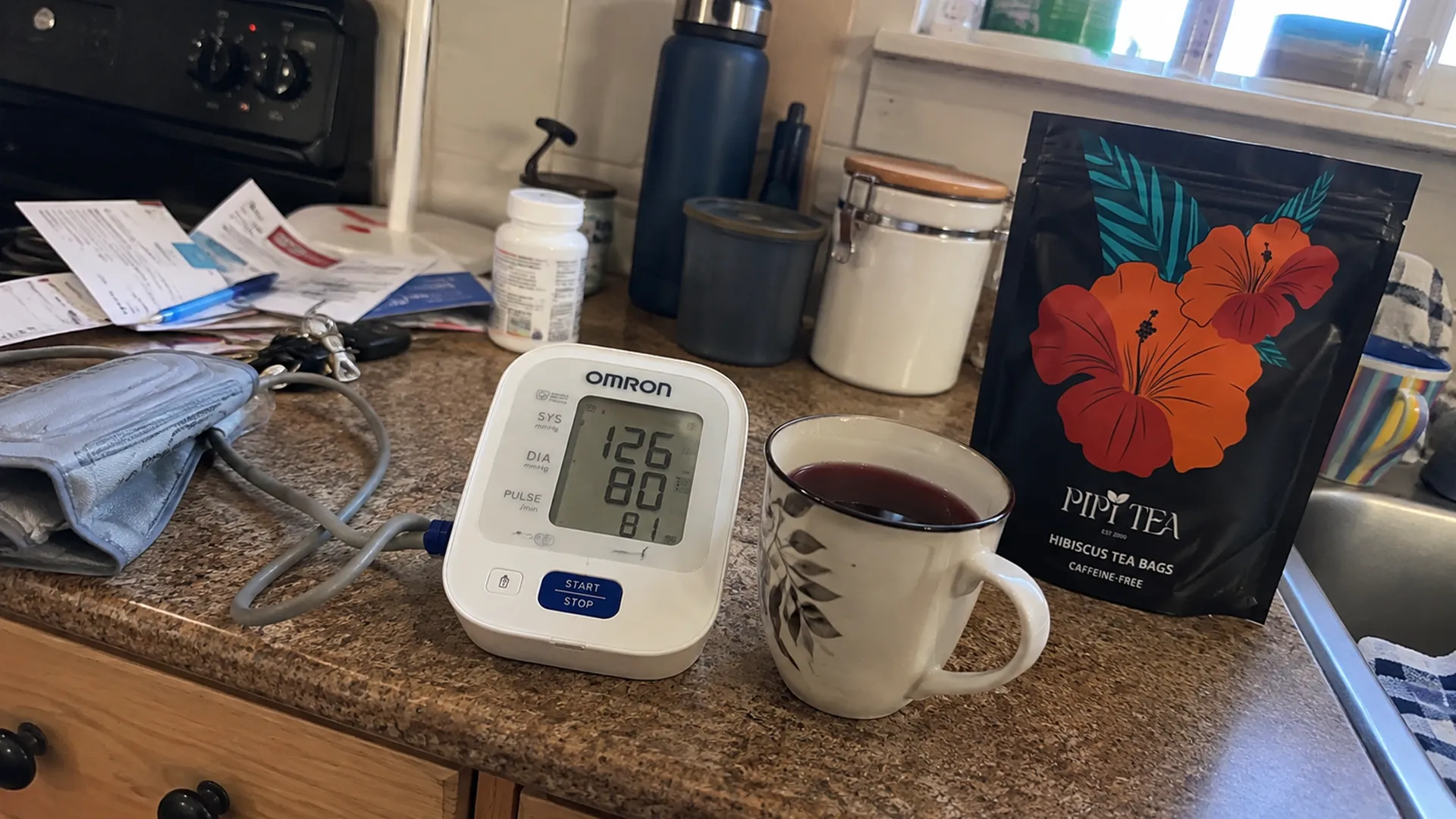
131/82. 129/81. 128/82. 130/81.
It just sat there. After two years of watching numbers slide, watching one hold still was the strangest feeling I've had in this whole business.
Week three: she got up at 6:15.
On a Saturday. And asked whether I wanted to walk the dog with her.
She hadn't done the six o'clock walk since May. Lately it had been ten, and mostly it had been me. I stood in the front hall with the lead in my hand, watching her tie her trainers the way she used to, and had to turn around so she wouldn't see my face.
I stayed sceptical. Scepticism is the most loyal thing I have left.
Week six: the pre-op panel.
The surgical team needed bloods before October 11th.
The nephrologist rang with the results. Her eGFR had come back at
41
.
Up two points.
He said: whatever you're doing, keep doing it. And he said he'd like to postpone the access consult and recheck her in three months.
She didn't say anything for about ten seconds, because she couldn't.
October 11th.
The appointment was still on the calendar, so we drove there anyway.
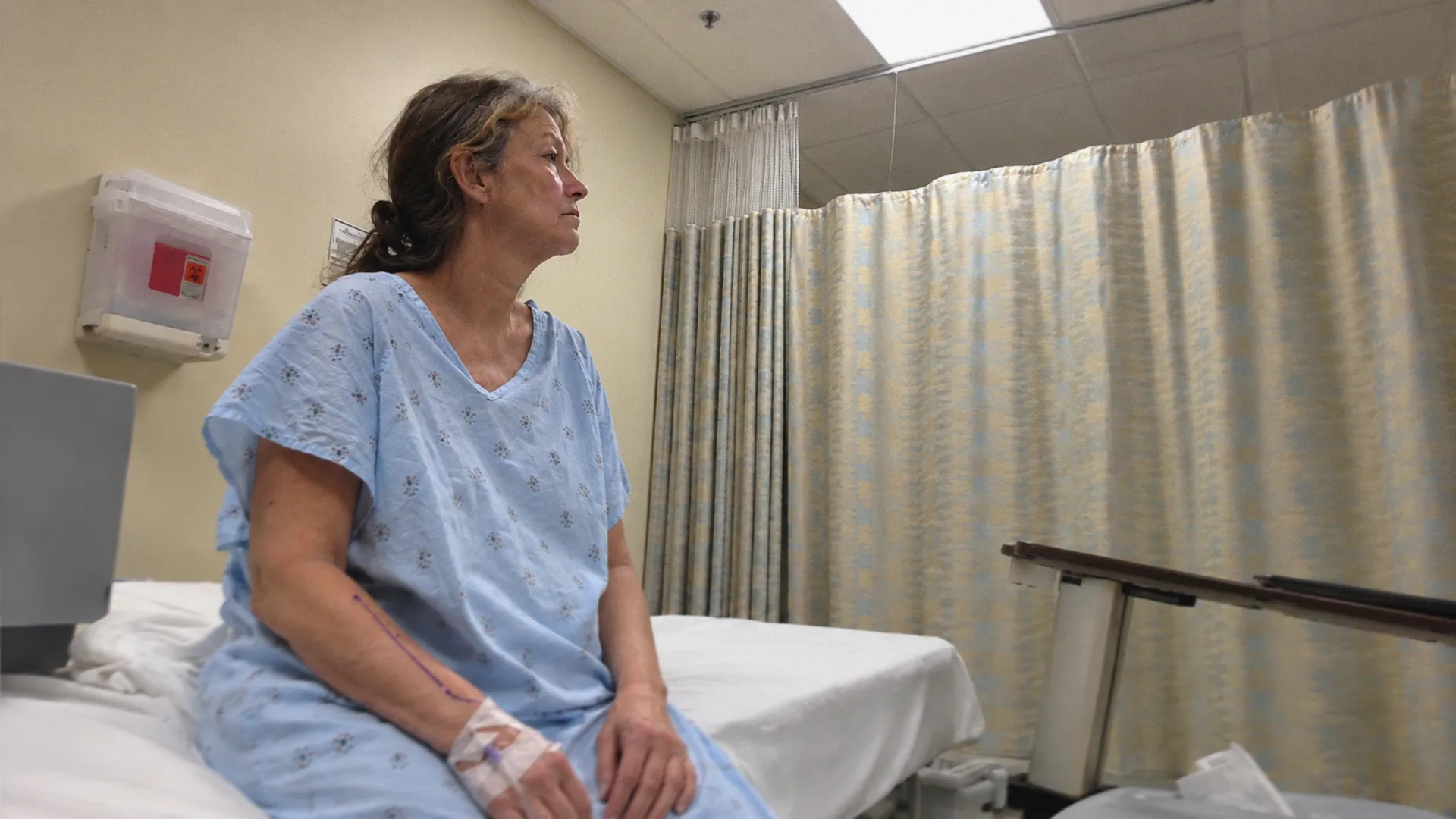
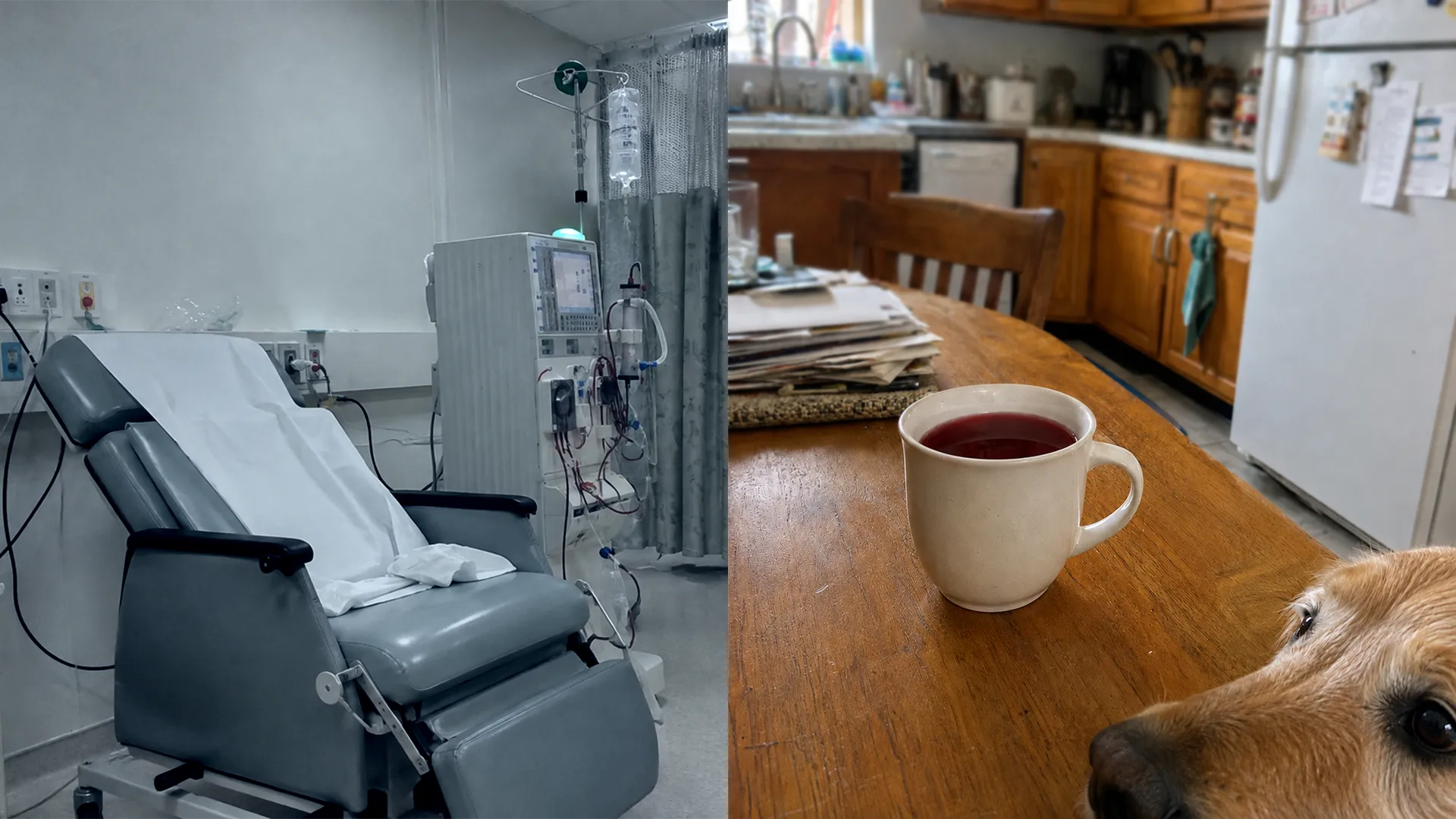
Linda put the gown on. They put the IV in her left hand. A nurse drew the purple line on her right forearm, where the access was going to go.
We were sitting in pre-op holding when the surgical coordinator came in and told us the nephrologist had reviewed the panel and wanted to hold off.
We drove home with the marker line still on her arm. She washed it off at the kitchen sink.
Three months later: 42.
He took the access consult off the surgical calendar entirely.
At my own recheck in January, mine held at 61. I'll take it.
THE RESULTS THAT HAVE DOCTORS SECRETLY ORDERING FOR THEMSELVES
![]()
Let me be very clear about what did and did not happen, because I've read enough pages like this one to know how they usually go.
Her kidneys did not heal.
The nephrons she'd already lost are still gone. That is not how any of this works, and anybody telling you otherwise is selling you something worse than tea.
What happened is that the slide stopped.
After two years of that number going down every single quarter, the slide stopping was the entire ballgame.
We're also not the only ones, and here I'll stick to what I can actually point at.
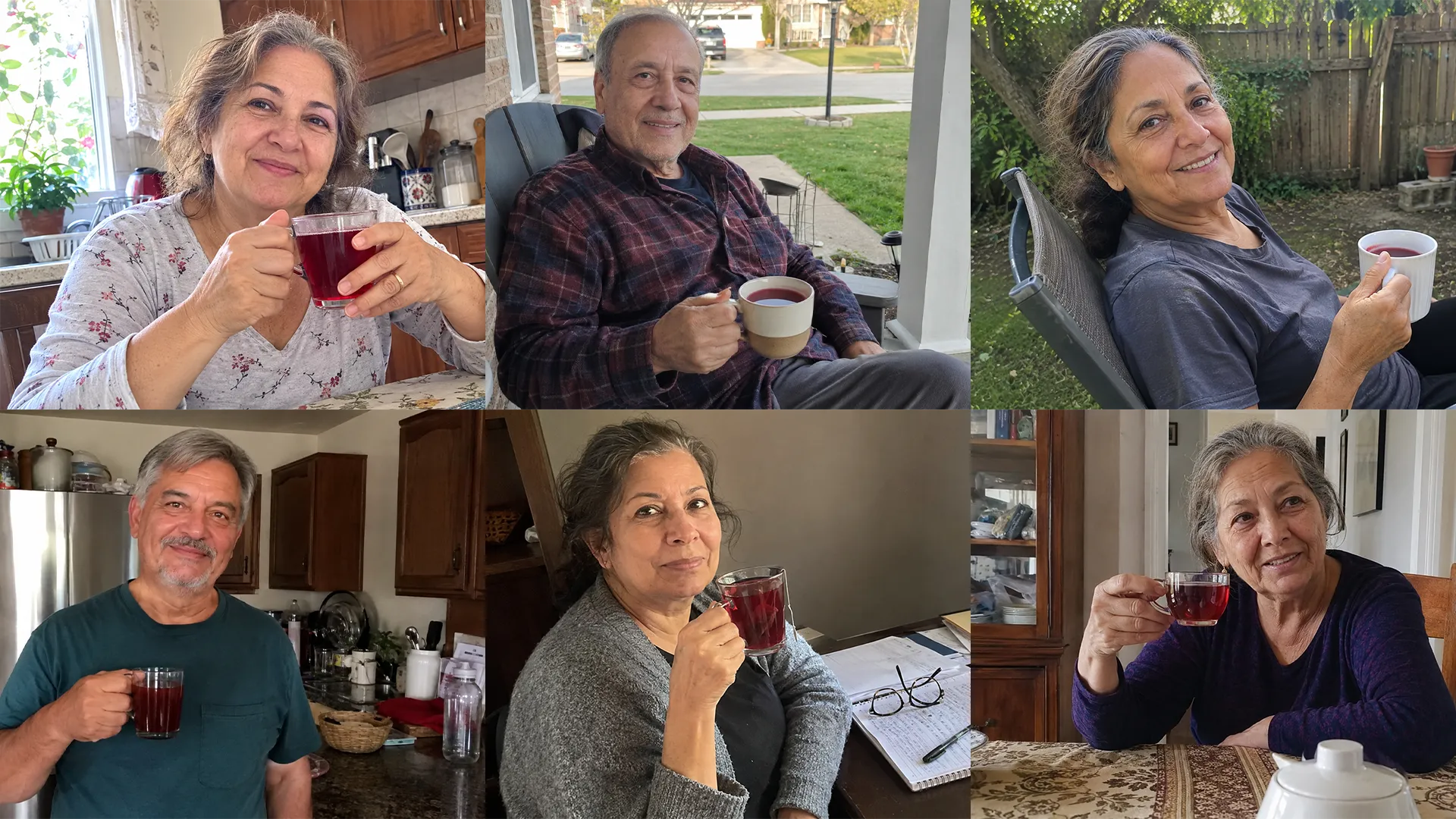
34,566 people have bought PiPi Tea in the thirteen months it has existed.
Thirteen months is also the honest answer to the question I'd be asking if I were you, which is: if this is real, why have I never heard of it? Because the company is thirteen months old. That is the whole explanation. There isn't a more interesting one.
The other number I'd want is the refund rate, because that's the one nobody can massage.
0.4%.
Four people in a thousand ask for their money back.
Then there are the people I've told.
My brother
, 65, on blood pressure medication and a statin, who can't take most supplements because of interactions. His pharmacist checked his whole list and said it was fine. No interactions, no potassium concerns at normal consumption. Two months in he rang to say his home cuff had been under 130 every morning for three weeks, and he hadn't seen numbers like that since he was 50.

Linda's sister Carol
, 68, who lost her husband to kidney complications four years ago. She ordered the night Linda told her about the postponement, and rang me later to say she wasn't letting another person in this family go the way Frank did.
Our daughter
, a nurse on a med-surg floor in Joliet, and her husband, who is prediabetic and had been getting warnings about kidney risk. His fasting glucose went from 110 to 102 in a month.
My neighbour across the street
, whose wife has Stage 3 at an eGFR of 47. He emailed three weeks ago to say Janet's had come back at 48. First time in fourteen months it had gone up instead of down. They were crying in the kitchen.
I had to close the laptop when I read that one.
WHAT KIDNEY DECLINE ACTUALLY COSTS IN AMERICA
![]()
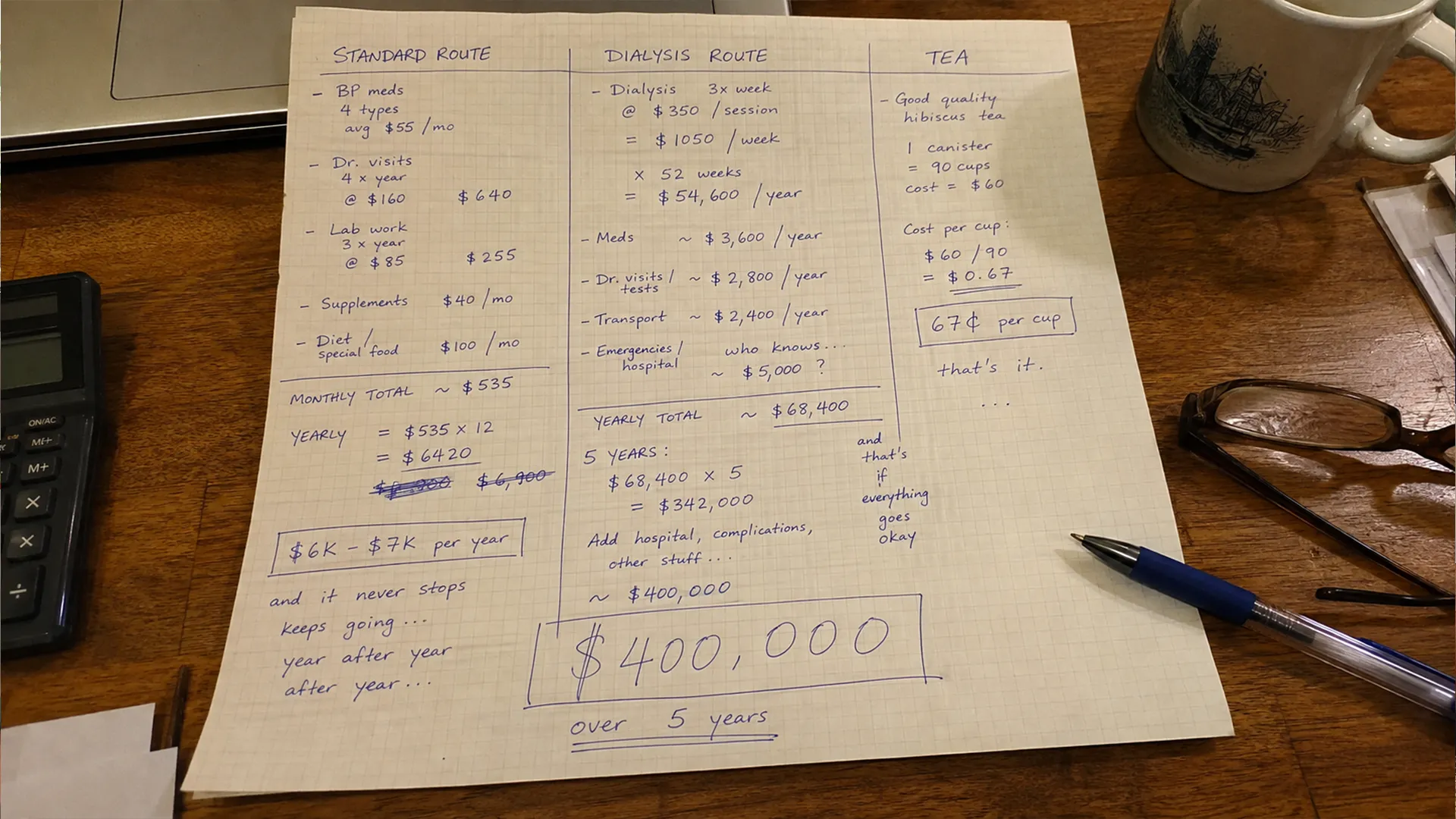
I'm an engineer. I costed it out, because that's what I do instead of sleeping.
If you follow the standard route and it holds:
appointments, medication, potassium supplements to replace what the medication strips out, quarterly bloodwork, and your whole life gradually organised around a schedule you didn't choose. Several thousand dollars a year, indefinitely.
If it doesn't hold:
access placement surgery runs
$30,000 to $50,000
. Then in-centre dialysis, estimated at over
$400,000 across five years
. Mondays, Wednesdays and Fridays. Four hours a session. And roughly four in ten people are still there at year five.
A daily cup of high-anthocyanin hibiscus works out at sixty-seven cents.
Call it $240 a year.
And here is the only part of this where I'm still genuinely angry.
There is an entire aisle of kidney products in every health food store in this country. Not one of the eleven bottles in my wife's cabinet addressed what actually takes nephrons. They sprinkle minerals and weeds at a problem that needs a real intervention. It's like handing somebody a watering can and telling them they're equipped for a house fire.
Nobody profits from explaining the difference between the whole flower and the dust. So nobody explains it.
I'm not telling you tea replaces your doctor. Linda still sees hers. She's still on lisinopril. She still gets the quarterly panel and we still open that portal with our stomachs in knots.
What I'm telling you is that for two years we had a measurement schedule and nothing carrying the load. Now we have both.
70% OFF, AND WHY I'M TELLING YOU RATHER THAN SELLING YOU
![]()
I'll give you the numbers rather than a pitch, because I'm not the one selling this and I'd only get the pitch wrong.
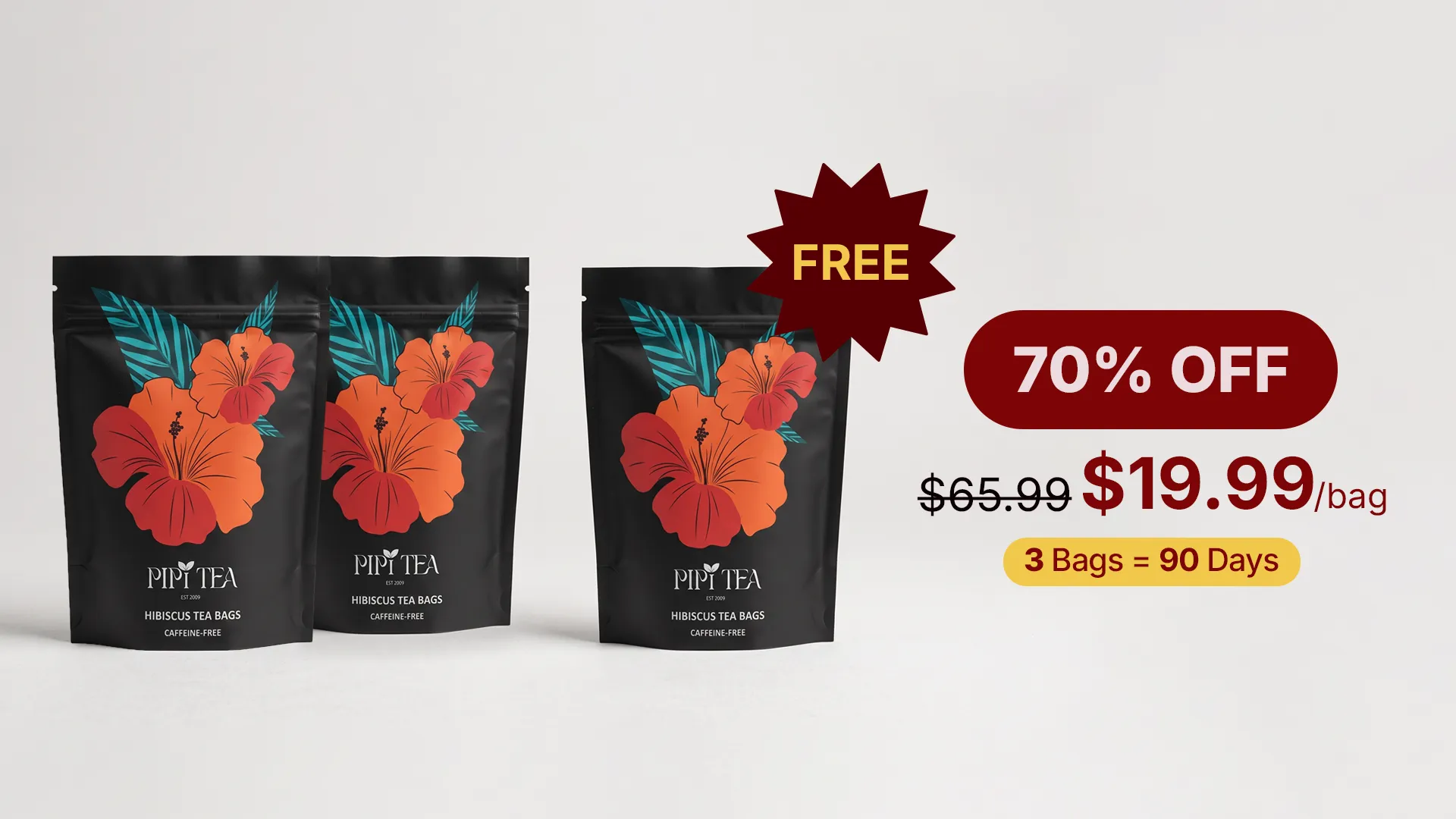
When I ordered for Linda it was $65.99 a bag.
What they're running now is buy two, get one free. Three bags for the price of two, which works out at
$19.99 a bag
.
Less than a third of what I paid, for the same thing.
I don't know what governs that or how long it holds, and I'd guess it moves with where they are in the harvest year, the same as everything else about this product.
● Regular price:
$65.99 a bag
, and a bag is 30 days
● Buy 2, get 1 free:
3 bags, 90 days, for $59.97
● Works out at:
$19.99 a bag
, or
67 cents a cup
● You save:
$138.00
, which is
70% off
I'll say one thing about taking three at once and then leave it alone, because I'm aware of how this sounds coming from a page trying to sell you something.
I didn't buy three because a website told me to. I bought three because of the harvest, which I'll explain in a second. One growing season a year means that if you run out at the wrong moment, you don't go shopping, you wait. Three months in the cupboard is cheap insurance against that. My father kept a spare water pump in the garage for forty years on exactly that reasoning, and used it twice.
BUT HERE'S THE PART YOU CAN'T GET AROUND
I asked about the supply, because a countdown clock on a website is the fastest way to lose me and I assume you're the same.
Here is the actual constraint.
Condition two on that list is hand-picked at peak harvest.
Peak harvest happens once a year.
That isn't a policy, it's a plant. You cannot run a second harvest because demand went up, and you cannot machine-strip it early without failing the condition that made it worth buying in the first place.
So there is one window a year, at altitude, and whatever comes out of it is the entire supply until the next one.
Thirty-four thousand people bought it in thirteen months. One harvest a year. You can do that arithmetic as well as I can.
When this season's supply is finished, the next harvest is 2027.
That's the whole story. No lawsuit, no injunction, nobody trying to shut anything down. It's a flower that blooms once a year and a lot of people who want it.
THE 90-DAY GUARANTEE, AND THE ONE NUMBER I'D CHECK
![]()
Ninety days. Every penny back, including shipping.
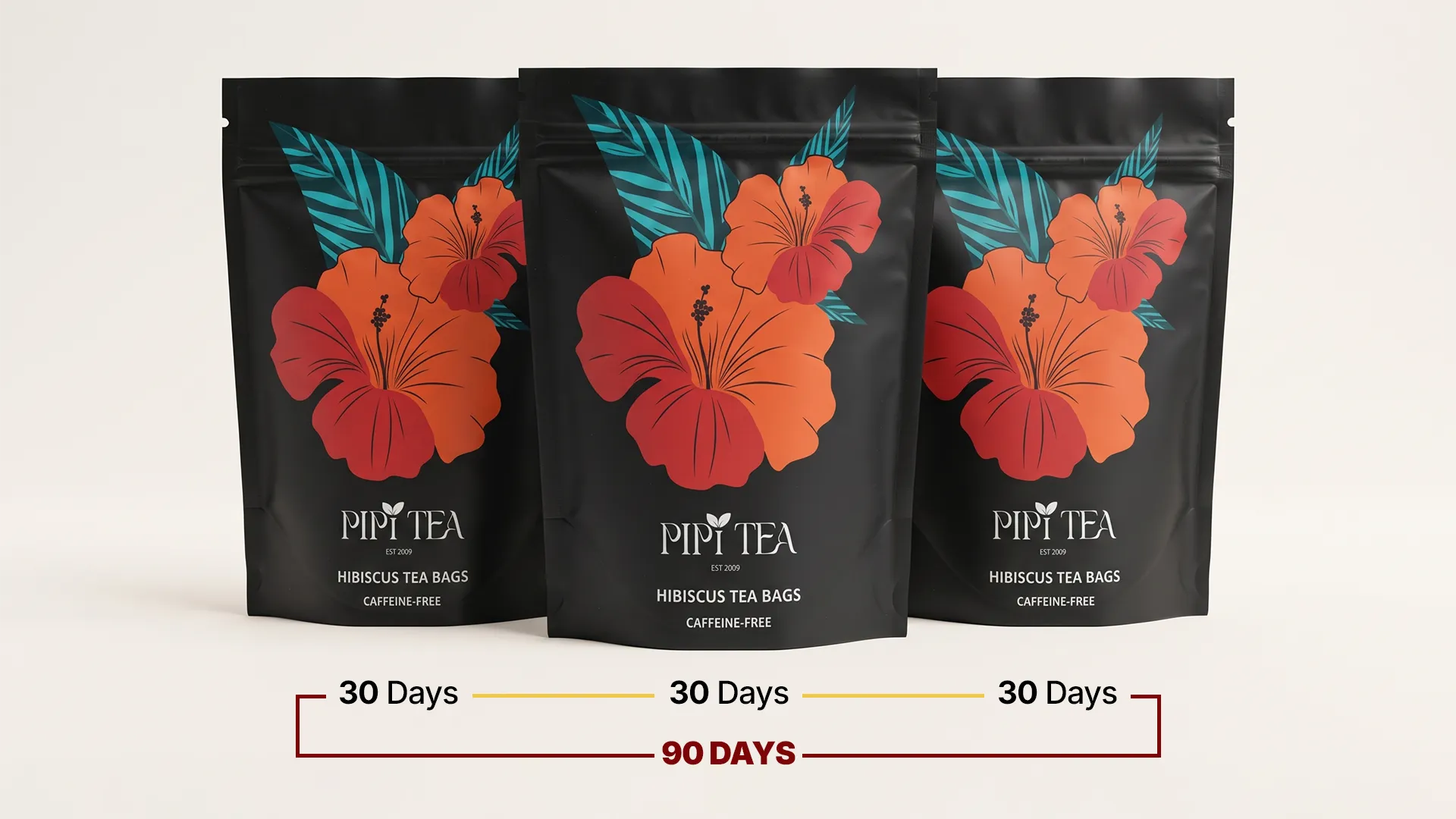
And look at what three bags actually is. Thirty days a bag, three bags, ninety days. The same ninety days the guarantee covers. You can drink every cup you paid for, right down to the last one, and still ask for all of your money back.
Drink it every morning. Take your blood pressure with a home cuff, which costs about thirty dollars and was the single best purchase we made through this whole thing. Write the numbers down. Then take your next lab panel.
If the numbers don't hold, if your pressure doesn't trend better, if you don't feel a difference, you get your money back. No forms. No store credit. Email support@pipitea.com with your order number and the word
refund
.
I'd rather you tested it properly than took my word for it. I wouldn't have taken mine.
The refund rate is
0.4%
. That's the number I'd point at if you asked me why I'm confident.
And if you want one more, it's the sentence Linda's own nephrologist said to me on the phone that Friday evening, after he'd told me I'd been using the wrong tool:
"If her oxidative burden had been lower from the beginning, if her pressure had stayed in range without medication fatigue, there's a real possibility her progression could have been slower. She might not be where she is now."
I had to put the phone down on the kitchen counter.
Because her own doctor had just told me my wife might not be where she was, if anybody had told us.
THE DECISION THAT WILL DEFINE YOUR NEXT DECADE
![]()
Right now you're standing where two roads split.
Path one: keep doing what you're doing.
Open the portal every three months with your stomach in a knot. Watch the number go the way it's been going. Get told to come back in three months. And in those three months, the load that's actually taking your filters keeps taking them, quietly, the way it did to Linda while we sat in our kitchen calling it a plan.
In two years you'll be in the same chair with a worse number, reading a different article about a different thing.
Path two: take some load off, starting tomorrow morning.
One cup. Eight minutes. Sixty-seven cents.
Protect what's still working, while protecting it is still something you can do.
I know which of those I'd choose now. I didn't know it two years ago, and that cost us more than I can write about in one sitting.
HERE'S EXACTLY WHAT HAPPENS NEXT
![]()
Step 1:
Click the button below.
Step 2:
Choose your package. The buy two, get one free bundle is 3 bags for $59.97, which works out at $19.99 a bag.
Step 3:
Enter your shipping details.
Step 4:
It arrives in 3-5 days.
Step 5:
Start the next morning. One tablespoon, hot water, eight minutes. Don't save it for a better day.
Step 6:
Buy a home blood pressure cuff if you don't have one, and write the numbers down every morning. You'll want your own evidence, and you should.
Whatever you do, don't close this thinking "maybe later."
I know exactly what later is, because we lived in it for two years.
Later is one more quarterly printout with a smaller number on it.
Later is the appointment where somebody says access placement and you watch your wife's face go still.
Later is sitting in a pre-op room at seven in the morning watching a nurse draw a purple line on the arm of the person you married 41 years ago.
There is no later. There's just the next three months, and what's happening to your filters during them.
The solution is one click away.
![]()
To whatever's left of your kidneys, and to the years they're holding for you,
Lou R.
Naperville, Illinois
CLAIM BUY 2, GET 1 FREE · $19.99 A BAG · 70% OFF
P.S.
Linda's pre-op bracelet is still in her sock drawer. I see it every time I put the laundry away. Wide white plastic, her name printed on it, her date of birth, a barcode, ALLERGIES: NKDA, and the date. 10/11. It's from the morning we sat in that room with the purple line on her arm, waiting, and then drove home with it still on her wrist. Neither of us could throw it out. Access placement surgery is estimated at $30,000 to $50,000. Five years of in-centre dialysis is estimated at over $400,000. The tea her own nephrologist said might have slowed her progression works out at sixty-seven cents a day, and right now the third bag is free. Ninety-day money-back guarantee. Please don't end up sitting in a pre-op room watching somebody draw a line on your wife's arm.
P.P.S.
If you're going to buy hibiscus, and I hope you do even if it isn't this one, check it against all five: whole flower, hand-picked at peak harvest, grown above 4,500 feet, traditionally processed, organic. Almost nothing on an American shelf meets all five and the packaging will not tell you. I found that out by ringing a company and asking. You can do the same. If it fails one, you're buying the dust, and I've already run that experiment on my wife for six weeks and paid for it with a point off her eGFR.
P.P.P.S.
The harvest is once a year. When this season's supply is finished, the next one is 2027. I don't have a countdown clock to show you and I wouldn't believe one if I did. It's a flower. It blooms when it blooms.
P.P.P.P.S.
Send this to anybody you love over 55. Especially the ones who are "fine" right now. Especially the careful one, the one who books everybody else's appointments. That's who Linda was.

6 · 41 min





 5 ·
2 h